There are two kinds of
ChatGPT enthusiasts: those who've lifted the hood and attempted to parse the ludicrously mysterious inner workings of artificial intelligence, and those content to reap the benefits without giving themselves a headache. I fell into the latter camp, which led me to keep referring to ChatGPT as GPT (and vice versa).As it turns out, they're not the same thing—at all. Referring to ChatGPT as GPT is like calling a Dell computer an Intel, the processor that powers it. And while Dell relies on Intel, Intel can power other computers, too.
Once I figured out the difference, I started noticing I wasn't the only person making this mistake. So I'm paying it forward: read on for the difference between GPT and ChatGPT.
What's the difference between ChatGPT and GPT?
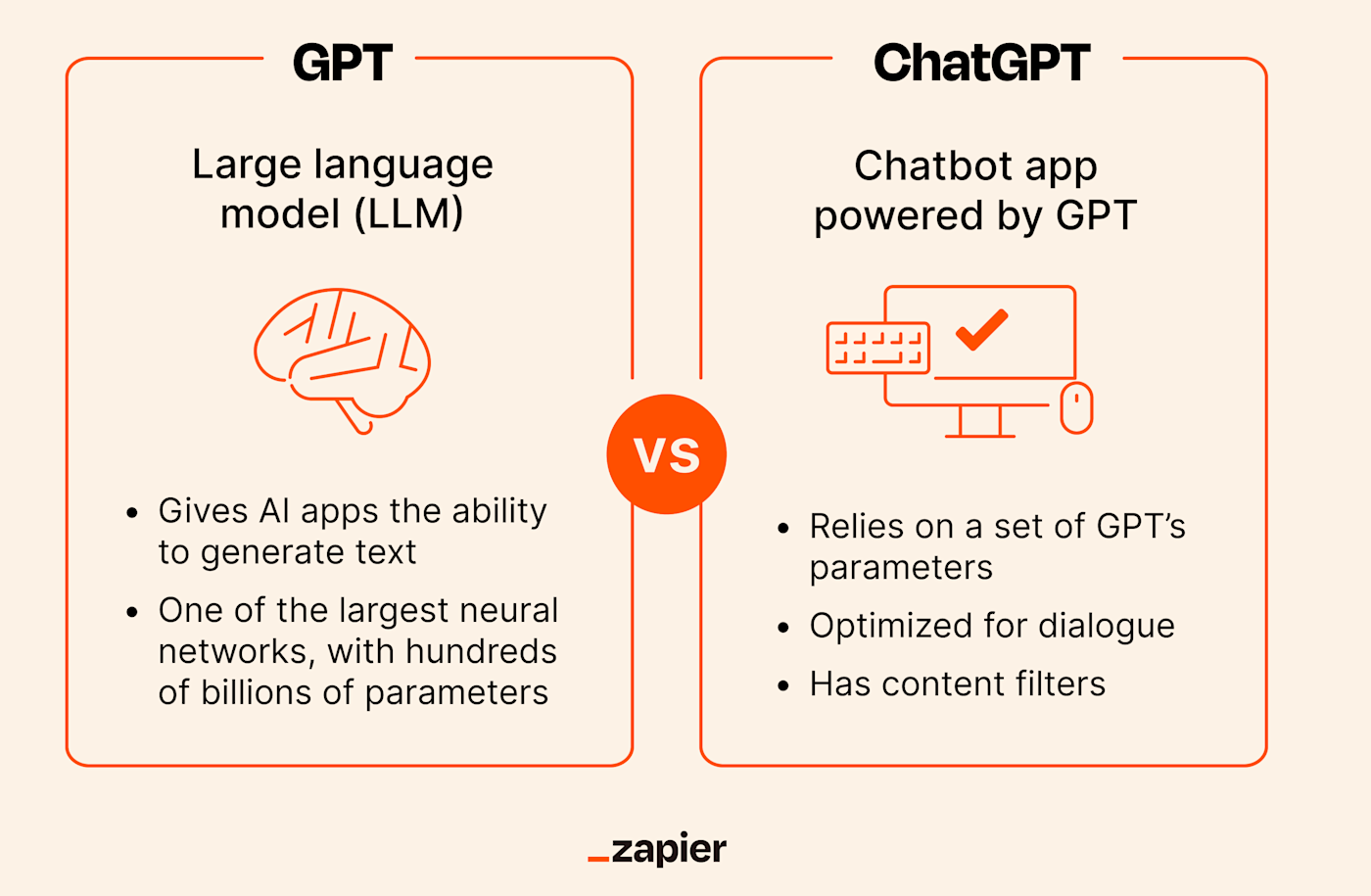
While both ChatGPT and GPT were built by the same research company, OpenAI, there's a key distinction:
-
GPT is a family of
AI models trained on terabytes of internet data that give artificial intelligence (AI) applications the ability to generate text. They're some the largest neural networks (modeled after the human brain) available: GPT-4 is rumored to have trillions of parameters that allow it to take aninput and churn out text that best matches your request. -
ChatGPT is an AI chatbot that uses GPT's models to interact with humans in a conversational way. It's
optimized for dialogue by human trainers, and it relies on GPT's parameters to produce convincing textual responses. OpenAI has also added content filters to stop it from going off the rails. And with the release ofGPT-4o, it can quickly do things like analyze images and have a decent voice conversation.
Revisiting the analogy above: if we think of ChatGPT as a Dell computer, then GPT is the Intel processor that powers it. After all, different computers can run on Intel processors in much the same way other AI applications can run on GPT.
ChatGPT is an app; GPT is the brain behind that app
ChatGPT is a web app (you can
access it in your browser) designed specifically for chatbot applications—and optimized for dialogue. It relies on GPT to produce text, generate images, and analyze data.GPT, on the other hand, is a language model, not an app. (There is an
OpenAI playground that lets you play around with GPT, but GPT itself isn't an app.) It can be tailored to build different functions, like text summarizing, copywriting, parsing text, and translating languages. And it has an open API that lets anyone tap into GPT to build their own AI applications with its functions. It's the brain behind ChatGPT, yes, but it's also the brain behind other tools likeJasper andWritesonic, or Bing's AI-powered search features.GPT is the industry standard for language models right now, just like ChatGPT is the industry standard for AI chatbots. But there are lots of folks playing catch-up. Google has released Gemini (the name of its
model and itschatbot), andClaude andMeta AI are in the game, too.What does this mean for integrations?
Even though GPT is a language model and ChatGPT is a chatbot, they each have their own open
API, which lets other apps connect to them. WithZapier, you can connectGPT orChatGPT to thousands of other apps to automate workflows with no-code.For example, you can get AI to write a business email from scratch—then automatically save it as a Gmail draft. Or it can score your leads based on their willingness to commit—then notify your sales team. Learn more about how to
automate GPT andChatGPT, or start with one of these pre-built workflows.Zapier is the leader in workflow automation—integrating with 6,000+ apps from partners like Google, Salesforce, and Microsoft. Use interfaces, data tables, and logic to build secure, automated systems for your business-critical workflows across your organization's technology stack.
Learn more.Never confuse ChatGPT and GPT again
So there you have it. ChatGPT is a chatbot. GPT is the AI model it was originally trained on. Don't you feel better knowing the difference? Hopefully without the headache.
Related reading:
- How does ChatGPT work?
- ChatGPT vs. Bard: What's the difference?
- ChatGPT vs. Bing Chat: Which should you use?
- How to build a custom version of ChatGPT with OpenAI's GPT builder
- What is Llama 2 and why does it matter?
This article was originally published in March 2023. The most recent update was in May 2024.